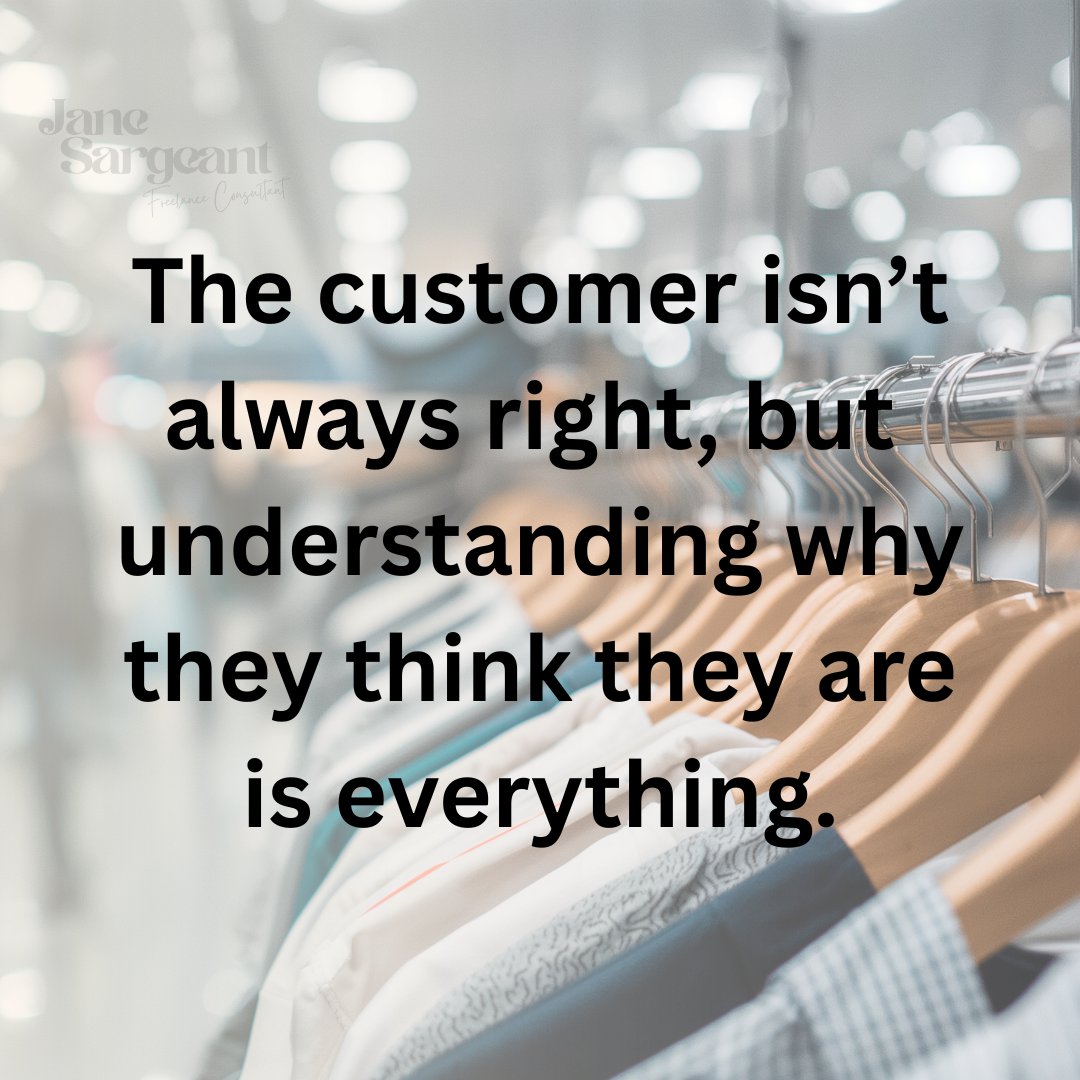
understanding why they think they are is everything.
Before I became a marketing consultant, I had a long and varied career in field sales and business development. But I actually began my career in retail, where I learned pretty quickly that the customer isn’t always right.
Every day after school, I would walk to the florist or the video store, where I’d work late, cash up, before heading home. During weekends and school holidays, I worked daily at the post office, the florist, the video shop, and Sainsbury’s.
Retail was my first real education in human behaviour. No marketing textbook has ever taught me as much.
In my early twenties, I joined Shoe Express, part of the Sears Group, on a management training programme. Within six months, I had my own store in Surrey and was taking home what felt like a huge salary at the time.
Then the company was acquired by JJB Sports. Stores were closed, restructures began, and I suddenly found myself in the deeply challenging role of closure manager. I was responsible for keeping multiple stores trading, maintaining morale and serving customers right up until the final day. The stress was relentless, the uncertainty constant, and it often felt unbearable.
But it taught me more about resilience, leadership under pressure and the importance of honest communication than almost anything else in my career.
Complaining for complaining’s sake?
Later, I moved into a frontline management role at TK Maxx, overseeing customer service and checkouts. Anyone who has worked a busy Saturday in retail will know it is not for the faint-hearted. It was here that I learned one of the most important lessons of my career: the customer isn’t always right. But understanding why they think they are is everything.
Most complaints are rarely just about the product or the price. They are about feeling unheard, undervalued or misled. The moment you understand that, you stop reacting to what someone is saying and start responding to what they actually need. I call this empathy in action. And empathy is the foundation of every piece of marketing that genuinely works.
Fast-forward to 2026, and retail has changed enormously. Customers have changed, too. They are more informed, more demanding and more time-poor than ever before. Online shopping has replaced much of the traditional weekly grocery run. Click-and-collect has become the norm. Retailers are restructuring their workforce, introducing night pickers, rolling out self-checkouts and reducing the human interaction customers have relied on for decades.
Nobody really asked customers whether they wanted any of this, and the response has been telling. Self-checkouts remain one of the most universally disliked developments in modern retail. The lesson? Never assume customers want what’s convenient for you. Understand what’s convenient for them, and build your business around that instead.
Death of the ‘saturday job’
But there’s another shift happening too. Increasingly, young people simply aren’t taking these kinds of part-time jobs anymore. The traditional Saturday job, once considered a rite of passage, has steadily declined.
I understand why. Young people today face enormous academic pressure and different career expectations from my own generation. There is a digital world full of alternative ways to earn money or spend their time. But I do think something valuable is being lost in the process.
Because retail teaches lessons that classrooms rarely can. It teaches resilience, patience and accountability. How to speak to people properly, deal with pressure, solve problems quickly and stay calm when there’s a queue of frustrated customers standing in front of you. (Especially when the customer isn’t always right, but thinks that they are.) It requires turning up on time even when you’re tired, supporting colleagues when things get difficult and understanding that the world does not revolve around you.
Character building
Those experiences shape you. They build confidence, emotional intelligence and commercial awareness in a way that is difficult to replicate elsewhere. Long before I understood marketing strategy, customer psychology or brand positioning, I understood people. This is because retail had already taught me how people behave when they feel stressed, rushed, disappointed, delighted or ignored.
Working in retail is physically demanding, often thankless and chronically undervalued in terms of pay. The people who do it well deserve far more credit than they receive. But what retail gives you in return is invaluable.
That understanding is what I bring to every marketing strategy I build today. Because marketing isn’t really about platforms, algorithms or content calendars. It’s about people. It’s about understanding what customers need, speaking to them in a way that resonates and building enough trust that when they are ready to buy; they think of you first.
#Marketing #Retail #CustomerExperience #Leadership #Business #MarketingStrategy #SmallBusiness #CareerJourney