
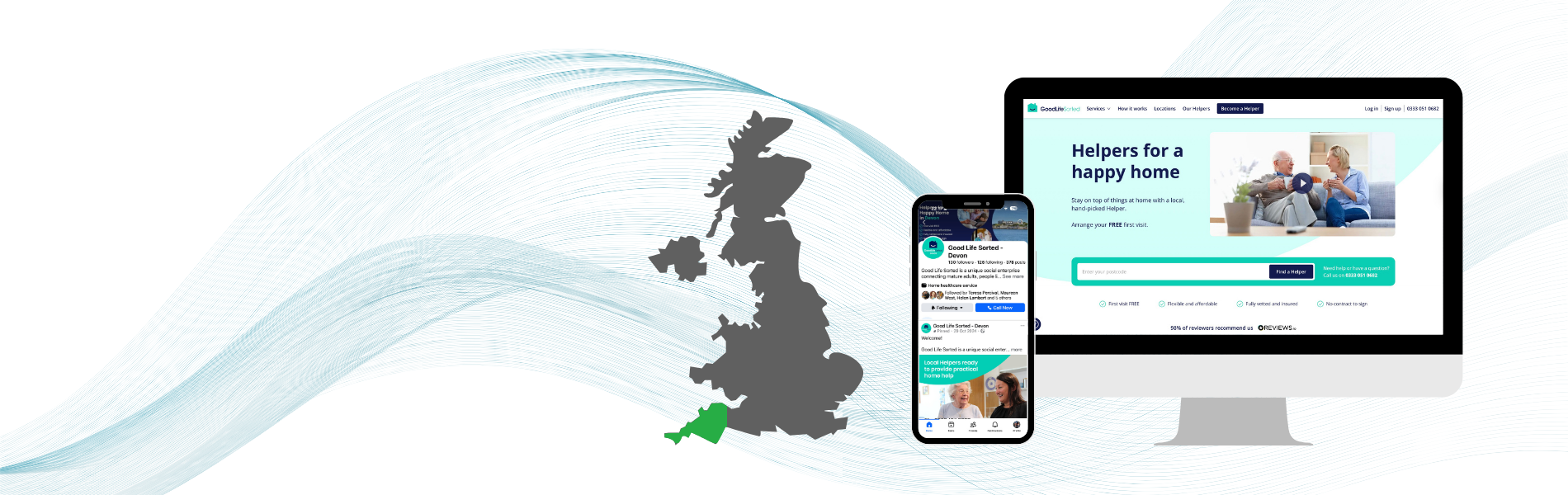
Launching a home help service from scratch across Devon and Cornwall — 200 referrals and 36 active helpers in 12 months
Client/Employer: Good Life Sorted Role: Regional Business Development Manager Region: Devon and Cornwall
Timeline: 12 months Starting point: Zero helpers, customers and brand presence in the region
The Brief
Good Life Sorted is a UK home help agency connecting people who need a little extra support at home with trusted local Helpers. Services range from companionship and light cleaning to shopping, meal preparation and post-hospital support, offering elderly and vulnerable people the means to maintain their independence with dignity.
When I joined Good Life Sorted to launch and grow the service across Devon and Cornwall, the organisation was at an early stage of its national expansion. There was no regional infrastructure, and no presence of any kind in the South West. My brief was simply to build it from the ground up.
Starting From Zero
There were local Facebook and Instagram pages, but they were each operated by the local Ambassador (a Helper with increased responsibility as part of their role – a team leader). The posts were all different as was the tone of voice. In Devon and Cornwall, there was no local brand awareness, no network of referral partners and no Helpers on the ground. Before any business development activity could begin, the foundations needed to be laid.
I created the regional Facebook presence and developed a set of standardised templates and guidelines for social media, ensuring that posts were consistent with the brand while allowing for the local storytelling that builds genuine community trust. The social media strategy balanced broad brand awareness content with testimonials and localised posts, sharing events I was attending, connections I was making, and stories that reflected the service’s real value in people’s lives.
Building a Referral Network and Navigating the Obstacles
I felt the most direct route to referrals in this sector would be through GPs and Practice Managers, so I reached out across Devon and Cornwall to introduce the service and invite them to refer patients. What I quickly discovered was that NHS guidelines prevent GPs from formally referring patients to paid-for services, which was a significant structural barrier that needed a creative solution.
Rather than pushing against a closed door, I found another way in. I connected with Volunteer Cornwall and used this as a bridge to meet the region’s social prescribers, a network of community-based practitioners whose role is specifically to connect people with non-clinical support services. The response was overwhelmingly positive. Social prescribers across the region were actively looking for exactly this kind of provision, and Good Life Sorted filled a genuine gap.
From there, I built a broad and diverse referral network across the South West, developing partnerships with:
- Age UK
- Devon and Somerset Fire Service
- Plymouth Argyle Community Trust
- Devon and Cornwall Food Association
- Plymouth Community Homes
- Plymouth Wellbeing Hubs
- The Motability providers in Plymouth
- Luke Pollard MP, Labour Member of Parliament for Plymouth
I attended community events, local cafés and DCFA pop-up events, handing out leaflets, building connections with other providers and speaking directly with members of the public who might benefit from the service or know someone who would.
Growing the Helper Network
Alongside the referral and partnership work, I was also responsible for identifying areas where we should recruit and onboarding the Helpers who would deliver the service. The two strands of growth, demand and supply, had to be developed in parallel.
We launched in Plymouth and steadily built momentum. By the end of the first year, the Plymouth area alone would have 36 active Helpers, with a further 6 in the process of onboarding. The second phase of growth extended further into Cornwall, expanding both the referral network and the Helper community across the wider region.
The Numbers
In the first month, I received 4 referrals — entirely expected for an unknown service entering a new market. What followed was a story of consistent, compounding growth.
Referrals quadrupled in the new year, rose again in spring, and despite a modest seasonal dip in summer, autumn delivered a further 33% uplift. Targeted with 45 referrals for Q2, I closed the quarter with 46.
By the end of the contract, the region had recorded 200 referrals in total — and Q4 2025 was the strongest quarter on record.
Results at a Glance
| Metric | Result |
|---|---|
| Starting position | Zero helpers, zero customers, zero brand presence |
| Total referrals | 200+ (and growing) |
| Q2 referral target | 45 |
| Q2 referrals achieved | 46 |
| Active Helpers recruited | 36 |
| Helpers onboarding at handover | 6 |
| Q4 2025 | Best performing quarter on record |
| Referral partners | NHS social prescribers, Hospital Discharge Teams, Volunteer Cornwall, Age UK, Plymouth Argyle Community Trust, and more. |
What This Demonstrates
This project required a rare combination of skills: the commercial instincts of a business development manager, the community knowledge of a local partnership builder, and the creativity of a marketer working without a team or budget.
When the obvious route was blocked, I found another way. When the infrastructure didn’t exist, I built it. And when the numbers needed to grow, they did, consistently, quarter on quarter, for twelve months.
If you’re launching a new service, entering a new market, or trying to build a referral network in a complex or regulated sector, this is exactly the kind of challenge I relish.

